

Overview
1st Conference on Sabah 2026: Digital-Energy Based Blue Economy Growth Initiatives (SDEBE 2026) is a proposed strategic conference focusing on the integration of digital innovation, renewable energy, blue economy development, sustainable infrastructure, connectivity, investment and trade, and community empowerment to support Sabah's economic transformation.
SDEBE 2026 is designed as a platform to bring together government agencies, industry leaders, investors, academics, technology providers, financial institutions, development partners and communities to discuss how Sabah can integrate its digital, energy, marine and economic assets into a more connected development model. The conference comes at an important regional juncture because BIMP-EAGA Vision 2035 was adopted in May 2026, establishing a new 10-year strategic roadmap for 2026–2035. Its four strategic outcomes include climate-smart agro-industry and fisheries, sustainable tourism, production hubs and regional value chains, and a future-ready workforce supporting the digital, green and blue economies.
The proposed corridors are intended to provide a spatial framework connecting economic resources, industrial clusters, ports, logistics infrastructure, SEZs, energy projects, digital infrastructure and regional markets. This approach is particularly relevant to the current BIMP-EAGA Vision 2035, which promotes interconnected economic corridors. production hubs, regional value chains, improved connectivity and stronger linkages between economic zones and regional and international markets.
At the same time, a new mechanism for monitoring and assessing the economic performance of the 8+2 Economic Corridors will be recommended. Feedback and input from all relevant sectors will therefore be sought to ensure that the proposed mechanism is aligned with the broader perspectives, priorities and strategic objectives of BIMP-EAGA and ASEAN. The mechanism will also facilitate the identification and interpretation of financing opportunities, including potential public, private, development-finance and regional funding sources, and enable practical solutions and recommendations to be formulated for consideration by the relevant ministries and agencies. In particular, the findings may be submitted to the Ministry of Energy Transition and Water Transformation, the Ministry of Economy, and the Ministry in the Prime Minister’s Department responsible for Sabah and Sarawak Affairs, as appropriate, for further follow-up and coordination. This approach is intended to strengthen intergovernmental collaboration and create new opportunities for integrated economic development across Sabah, Sarawak and the wider Borneo region, in line with the aspiration of building “One Malaysia” through stronger regional connectivity, shared economic opportunities and inclusive development.
In this way, Federal funding would not be viewed simply as infrastructure expenditure, but as strategic investment in Sabah's economic growth corridors, with each corridor having a defined economic function, development pipeline, investment target and measurable contribution to Sabah's GDP and regional economic integration.
LAUNCH OF 8 (BLUE) AND 2 (GREEN) SABAH ECONOMIC CORRIDORS
A central feature of SDEBE 2026 is the proposed launch of eight Sabah Blue Economic Corridors and two Green Economic Corridors, namely:
Tuaran–Sulaman–Kota Belud Economic Corridor
Limau-Limauan–Marudu Bay Economic Corridor
Sepanggar–Kota Kinabalu–Gaya Economic Corridor
Kudat–Pitas–Banggi–Palawan Economic Corridor
Sipitang–Labuan–Lawas–Brunei Economic Corridor
Paitan–Beluran–Sandakan–Kinabatangan-Taganak Economic Corridor
Lahad Datu–Kunak-Semporna–Bongao Economic Corridor
Tawau–Sebatik–Nunukan Economic Corridor
Central Sabah Economic Corridors
Southern Sabah Economic Corridor


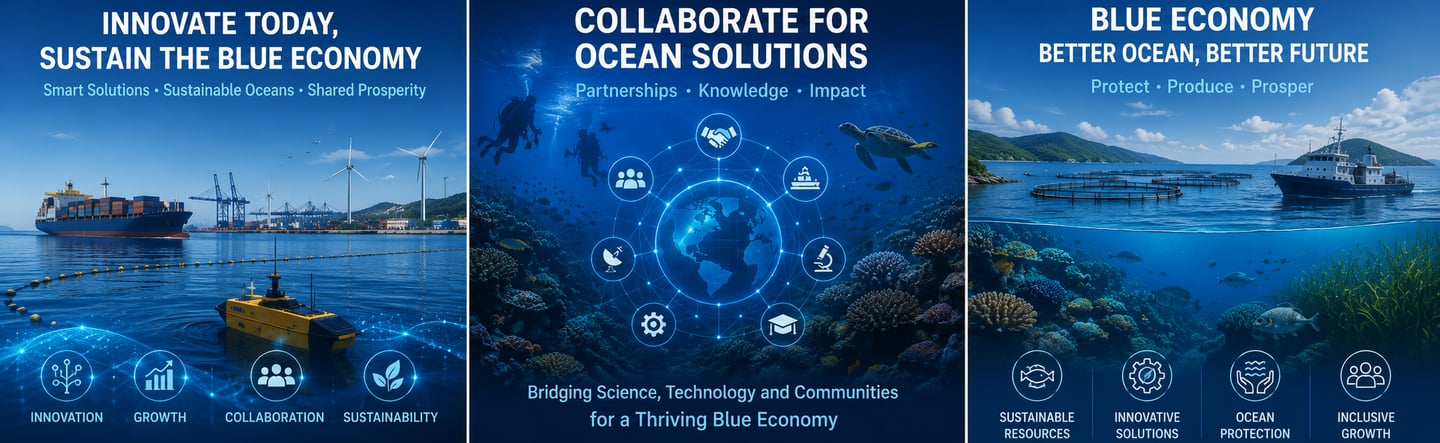
8 STRATEGIC PILLARS OF SDEBE 2026
DIGITAL INNOVATION & AI - Promoting digital infrastructure, artificial intelligence, data-driven economic planning, digital trade, smart communities, digital government and technology-enabled public and private services. This pillar supports the development of smart economic corridors, digital businesses, data centres and AI-enabled industries.
RENEWABLE ENERGY & ENERGY SECURITY - Accelerating Sabah's transition towards solar, wind, hydro, energy storage, smart grids and regional electricity connectivity, while strengthening long-term energy reliability and affordability for communities, industries and SEZs.
BLUE ECONOMY & MARINE RESOURCES - Developing Sabah's marine and coastal resources through sustainable fisheries, aquaculture, seaweed, marine biotechnology, blue carbon, coastal and marine tourism, maritime services and other ocean based industries.
SUSTAINABLE & CLIMATE-RESILIENT DEVELOPMENT - Ensuring that economic growth is supported by environmental protection, climate resilience, resource efficiency, biodiversity conservation, low-carbon development and sustainable use of land and marine resources.
CONNECTIVITY, PORTS & SMART INFRASTRUCTURE - Integrating ports, roads, airports, maritime routes, logistics networks, digital infrastructure, water, electricity and energy systems to improve the movement of people, goods, information and energy. This pillar is particularly important because reliable transport, port, logistics, electricity, water, telecommunications and digital infrastructure must support the economic corridors.
INDUSTRIAL DEVELOPMENT, SEZs & VALUE CHAINS - Developing industrial clusters, Special Economic Zones (SEZs), downstream industries, manufacturing, processing, logistics hubs and regional value chains based on the economic resources and competitive advantages of each corridor.
INVESTMENT, TRADE & BIMP-EAGA MARKET INTEGRATION - Creating investment-ready economic corridors supported by investment facilitation, trade development, export promotion, regional supply chains, cross-border trade and market access to BIMP-EAGA, ASEAN and international markets.
COMMUNITY EMPOWERMENT, FOOD SECURITY & FUTURE WORKFORCE - Ensuring that corridor development generates inclusive opportunities for SMEs, local entrepreneurs, farmers, fisherfolk, coastal communities, youth and skilled workers, while strengthening food security, agro-industry, skills development, entrepreneurship and future-ready human capital.
This pillar ensures that large-scale infrastructure and investment translate into local participation, employment, income generation and community economic opportunities.


WHO SHOULD ATTEND?
Government & Policymakers
Academia & Research
Industry & Business
Investors & Financial Institutions
International Organizations
Innovation & Entrepreneurship
Environmental & Community Organisations
Agriculture, Fisheries & Marine Sectors
Digital & Emerging Technology Professionals
Renewable Energy & Infrastructure
Young Professionals & Future Leaders
WHY SHOULD YOU ATTEND?
Participants will gain opportunities to:
Connect with government leaders, industry executives, researchers, investors, and innovators.
Learn from internationally renowned keynote speakers and subject matter experts.
Present groundbreaking research, technologies, and best practices.
Discover emerging trends in the Blue Economy, Artificial Intelligence, renewable energy, and digital transformation.
Explore funding, investment, and commercialization opportunities.
Build strategic partnerships across Sabah, the BIMP-EAGA region, ASEAN, and the global community.
Contribute to shaping policies and strategies that drive sustainable economic growth and regional integration.
Experience technology demonstrations, innovation showcases, and business networking sessions designed to foster impactful collaboration.
EXPECTED CONFERENCE OUTCOMES
SDEBE 2026 is structured as an action-oriented platform designed to produce practical outcomes, strategic recommendations and implementable initiatives, rather than serving solely as a discussion forum. Its overarching aim is to position Sabah as an integrated digital-energy and blue economy platform within BIMP-EAGA and ASEAN by connecting renewable energy, digital innovation, marine resources, economic corridors, ports, industries, investment and communities into a sustainable and inclusive regional growth ecosystem. This positioning is aligned with the current BIMP-EAGA Vision 2035, which promotes an integrated and spatial approach to economic corridor development, including stronger regional production networks, digitalization, blue economy opportunities, sustainable development, investment, value chains and improved physical and energy connectivity. BIMP-EAGA's new framework specifically seeks to develop interconnected economic corridors that link production centres with supply chains and regional and international markets.
The outcomes, recommendations, project proposals and stakeholder feedback generated through SDEBE 2026 will be consolidated into a Conference Outcome and Strategic Action Report for submission to the Setiausaha Kerajaan Negeri Sabah and the Minister in the Prime Minister's Department (Sabah and Sarawak), as appropriate, for consideration, policy integration and further implementation in support of Sabah's development priorities. Where appropriate, proposed projects arising from the conference may also be further developed into investment-ready project concepts, economic corridor programmes, public-private partnership initiatives and potential Federal or State development funding proposals, subject to the relevant government planning, appraisal and approval processes. This approach is consistent with BIMP-EAGA's current project framework, which emphasizes projects with defined concepts, implementation plans, results frameworks, cross-sector collaboration and alignment with BIMP-EAGA objectives.


Sabah Blue Economy Business Community
Fostering economic growth in BIMP-EAGA region.
Connect
Support
+6016-883-7168
© 2026. All rights reserved.